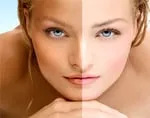
With summer here, your upcoming plans for vacation most likely involve spending some time in the sun. But are you going to lather yourself in SPF-100 sun block, or embrace the rays in hopes of achieving a deep brown tan like Snooki or Pauly D from the Jersey Shore?
Everyone is well-versed in the potentially harmful effects of getting too much exposure to the sun, yet many still spend countless hours in the sun working on their tan. Like anything else, you can blame the media’s influence. After viewing models with photo-shopped tans, women express more favorable attitudes toward tanning compared to another group who saw the same model without a tan.1 Researchers found the same effect with a separate group of participants looked at magazine advertisements featuring tanned vs. non-tanned models.
Yet, people aren’t merely the media’s puppets. When people choose to tan, the major motivating factor is to improve their general appearance.2 Another study found that those concerned with appearing attractive had more incidental sun exposure, but also worried (appropriately so) more about skin cancer and the sun’s effect on aging.3 The problem is that individuals who tan in order to appear more attractive may actually be right. For example, adolescents who viewed pictures of other tan vs. non-tan individuals viewed those with a tan as more attractive and healthy.4 Similarly, males rated a woman with a dark tan (versus light or medium) as thinner and more physically attractive, and as healthier than the woman with a medium tan.5
Now, before you go rushing out to the nearest beach or tanning salon, a quick SofR public service announcement. Self-presentation strategies, or the things you do to make others view you favorably, can involve all sorts of unhealthy behaviors.6 In this context, tanning is in some really bad company as a potential cancer causing behavior along with things like smoking and excessive drinking/drug use. Sure, everyone would like to present themselves as more attractive. But think of what it may mean later on when your older and sitting on a beach chair.

If that picture isn’t enough to gross you out and make you think twice about tanning, maybe thinking of death will do the trick. Research shows that when women focused on the possibility of death they said that they planned on using proper sun protection.7 However, among women who were led to see a connection between tanning and attractiveness, thinking of death indirectly led to more interest in tanning behavior, perhaps as a way to bolster self-esteem. So this summer when you head out to do a little GTL, make the T stand for “taking time to apply sunscreen.”
Interested in learning more about relationships? Click here for other topics on Science of Relationships. Like us on Facebook to get our articles delivered directly to your NewsFeed.
1Mahler, H. M., Beckerley, S. E., & Vogel, M. T. (2010). Effects of media images on attitudes toward tanning. Basic and Applied Social Psychology, 32(2), 118-127.
2Cafri, G., Thompson, J., Roehrig, M., van den Berg, P., Jacobsen, P. B., & Stark, S. (2006). An investigation of appearance motives for tanning: The development and evaluation of the Physical Appearance Reasons For Tanning Scale (PARTS) and its relation to sunbathing and indoor tanning intentions. Body Image, 3(3), 199-209.
3Heckman, C. J., Wilson, D. B., & Ingersoll, K. S. (2009). The influence of appearance, health, and future orientations on tanning behavior. American Journal of Health Behavior, 33(3), 238-243.
4Broadstock, M., Borland, R., & Gason, R. (1992). Effects of suntan on judgments of healthiness and attractiveness by adolescents. Journal of Applied Social Psychology, 22(2), 157-172.
5Banerjee, S. C., Campo, S., & Greene, K. (2008). Fact or wishful thinking? Biased expectations in ‘I think I look better when I’m tanned. American Journal of Health Behavior, 32(3), 243-252.
6Leary, M. R., Tchividijian, L. R., & Kraxberger, B. E. (1994). Self-presentation can be hazardous to your health: Impression management and health risk. Health Psychology, 13(6), 461-470.
7Routledge, C., Arndt, J., & Goldenberg, J. L. (2004). A time to tan: Proximal and distal effects of mortality salience on sun exposure intentions. Personality and Social Psychology Bulletin, 30(10), 1347-1358.

Dr. Gary Lewandowski – Science of Relationships articles | Website
Dr. Lewandowski’s research explores the self’s role in romantic relationships focusing on attraction, relationship initiation, love, infidelity, relationship maintenance, and break-up. Recognized as one of the Princeton Review’s Top 300 Professors, he has also authored dozens of publications for both academic and non-academic audiences. 


